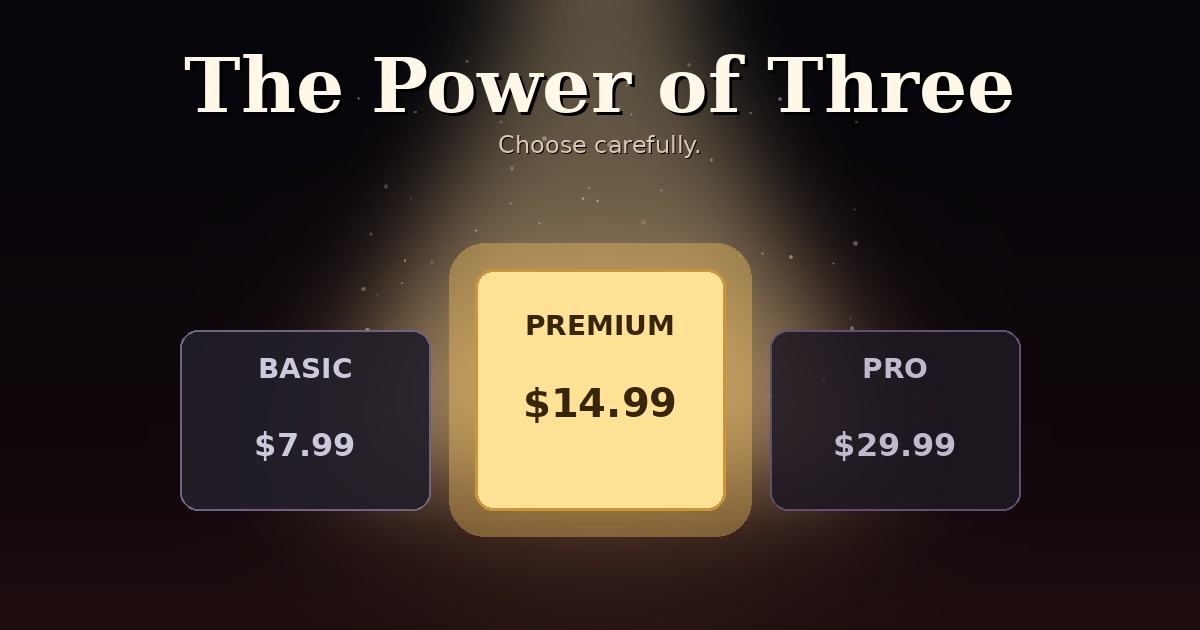
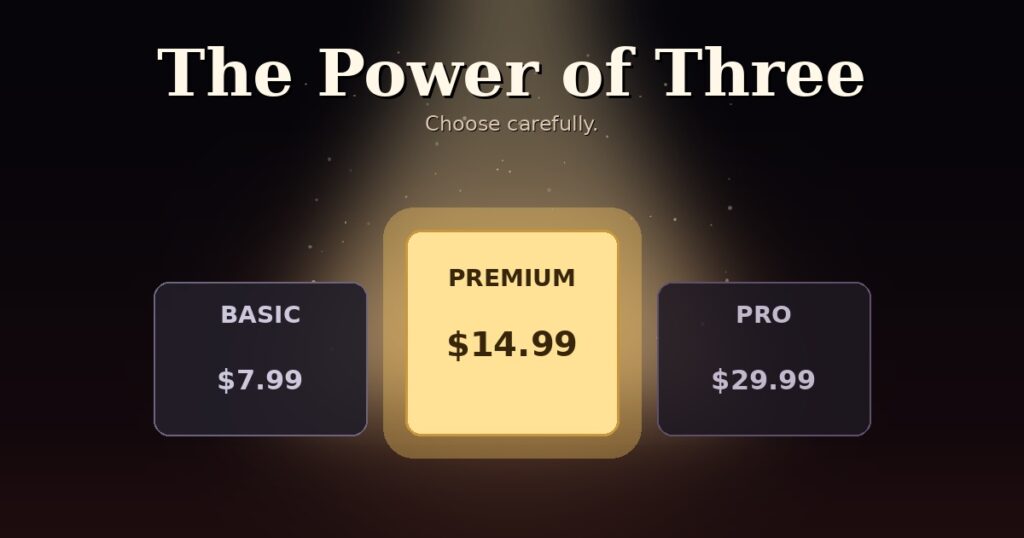
Say your free trial period in a service has expired and you wish to continue using it. Let’s assume that the company offers you two pricing choices: a “Basic Plan”, priced at, say, $7.99, which covers only a few available features, with a few exceptions, more or less the ones you had already been using, and a “Premium Plan” at a price of $14.99, with more available usage features. The difference is that the Premium version costs a bit more than the Basic Plan. What is your choice?
The logical action is that, since your usage can be covered by the Basic Plan, the Econ would continue with this option. The few exceptions of features that would be nice to have and are covered by the Premium Plan could be considered a relatively acceptable loss to bear. So, as an Econ user, you are ready to follow through with the payment for the Basic Plan.
Now enters the third option. Right before your checkout, the company offers you a third option, the “Pro Plan” at a price of $29.99. This option is the most expensive of the three and covers more features than you would ever imagine. Immediately, since we are not actually Econs, you feel that this option is a bit extreme. But the problem is that this option was never placed as an actual option plan; it was really used as a decoy. So now the second thing that comes to mind is the fact that for some reason the second option, the Premium Plan, now looks more tempting, as it covers all of your needs and even though it costs more than your initial choice, it is far cheaper than the third option. Now the loss of the rare features that you would potentially require starts to weigh on you more. Congratulations, you have now fallen victim to the anchoring and the decoy effect.
“Anchoring Effect” is when people make numerical decisions affected by information given (“anchor”), even if it is arbitrary, moving away from their starting point. This is because their System 1, the automatic part of their brain, is actually in motion. (Tversky & Kahneman, 1974). The “Decoy Effect”, also known as the “Asymmetric Dominance Effect” is basically when the addition of a third option, increases the probability of selecting another option, even though, nothing has changed in the original options (Huber, Payne, & Puto, 1982).
What is interesting is the fact that people in situations like these, continue deliberating between their original options. But now it is under the shadow and weight of the third option. Of course there are those that would choose the third option, the most expensive one, and that would be a surprising win for the company. But overall, the choice is between the two. This conundrum is a tool at the companies’ disposal, in order to gain more money from more customers. In economic theory it is known as second-degree price discrimination. This way, the companies do not need to adjust their prices to the customers; rather they allow the customers to categorize themselves based on their willingness to pay. So, in a final note, since you are now aware of the little choice games that companies play on consumers, here’s what you should do the next time you are in such a position. It would be best to start using the System 2 of your brain, the one that makes the tough choices. This way, the tendency to follow your instinctive thoughts will probably diminish and you will make a decision based on your actual needs and not the ones made for you.
Leave a Reply